How I led it
From a casting bottleneck to a company-wide operating model.
The CEO’s mandate was to start with casting. I sat with the casting director and mapped one show from channel brief to signed contract. Every hand-off ran through him, and its hand-typed spreadsheet held seven tabs and 223 actors. His 15 years of casting judgement were what mattered; the manual coordination around each decision was what slowed every show down.
The same pattern appeared across Finance, Administration, Operations and HR. Instead of eight disconnected bots, I designed a single system around one hard boundary: agents prepare the desk work, and authorised people approve anything that moves money, alters records or leaves the company.
Eight departments and a read-only CEO desk.
Casting, Creative, Operations, Finance, Accounts, HR, Administration and Marketing each own their domain and data scope, alongside a read-only desk for budgets, headcounts and pending alerts. Backend code checks every request against the employee directory and masks pay and billing outside owning teams.
Built solo, run like an engineering team.
AI coding agents traced the codebase, wrote tests before implementation and reviewed each change with a separate model. I owned the user-facing rules, approval boundaries and every release, and built a 208-case benchmark (three trials each) covering routing, cross-team work, permissions, approvals and safety.
The trade-off
One assistant to message, and one more step in every request.
When expanding beyond casting in June 2026, I first built a separate agent for each team. Four days in, I changed course: staff would have had to know which specialist to message and repeat context whenever an issue crossed teams, such as a shoot overage needing both a purchase order and a budget revision.
I placed one coordinator, Bodhi, in front of all nine specialists. Staff describe what they need once in Slack or WhatsApp; Bodhi briefs the right specialists in parallel or in sequence and replies in one voice. Bodhi has no action tools of its own, so it can only route and summarise; it cannot pay a bill, change salaries or send a contract.
The cost is one extra hop per request. On the benchmark, the median reply took about 20 seconds, roughly 1 in 30 requests went to the wrong specialist, and 7 in 10 cross-team requests succeeded.
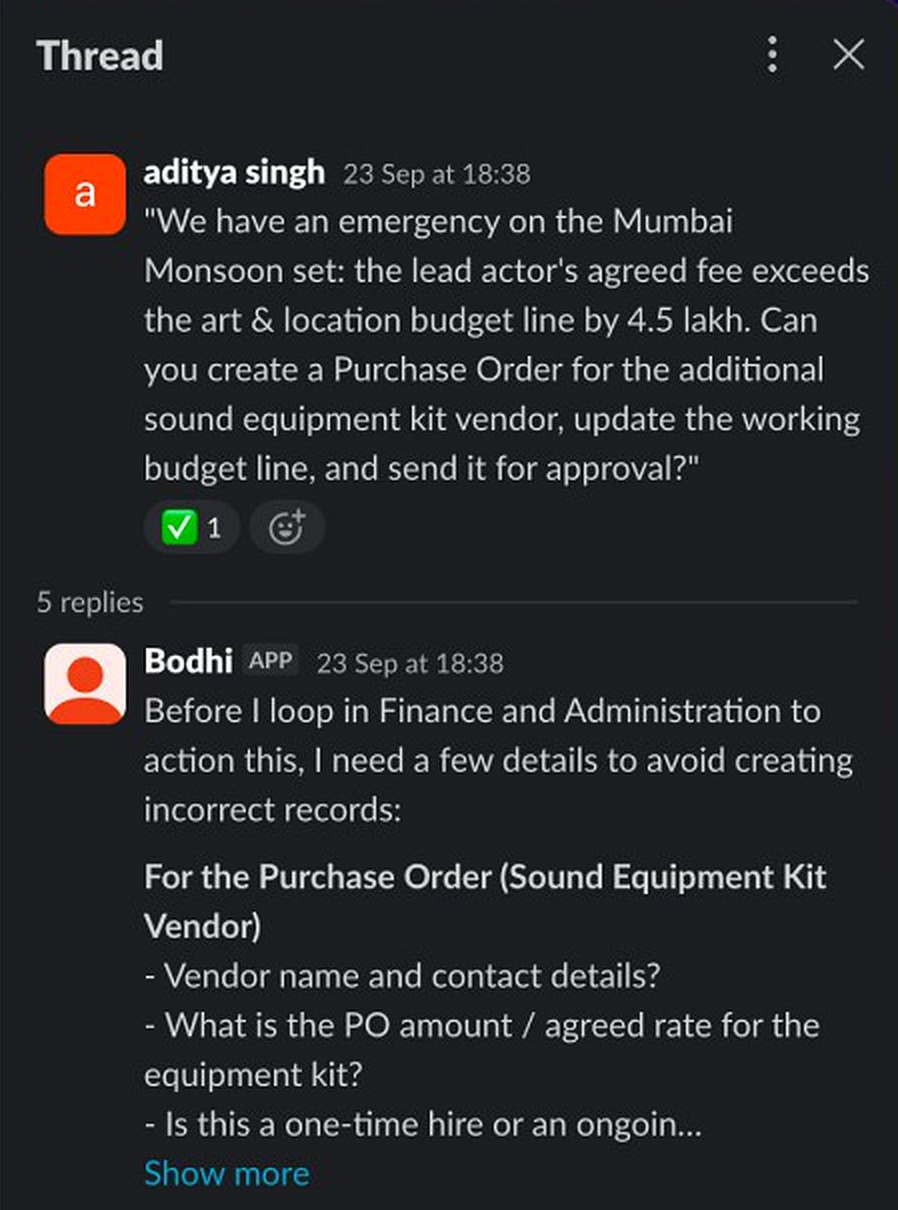
Slack for internal operations; WhatsApp for casting.
Casting stayed on WhatsApp, with plain-text replies and no buttons, because casting directors work from their phones. As the system expanded to eight departments, Slack became the main internal surface so threads keep cross-team work clear and interactive cards let managers approve requests in place. A web workspace sits beside both for desk review of rosters, documents and pending approvals.
Approval rules moved from prompts into code.
Prompt instructions did not reliably stop the model before high-stakes actions. I moved the gate into backend code: the runtime halts the call, stores the exact parameters as a pending approval and blocks execution until an authorised person confirms.
What shipped
Built inside Slack and WhatsApp, with human sign-off on every consequential action.
Across the Slack build, purchase orders, budget revisions, expense claims and leave requests pause on interactive approval cards with spending limits and escalations at 20, 40 and 60 minutes. Below is the deployed casting workflow on WhatsApp, from script to contract, where the same code-enforced pause runs in plain text.
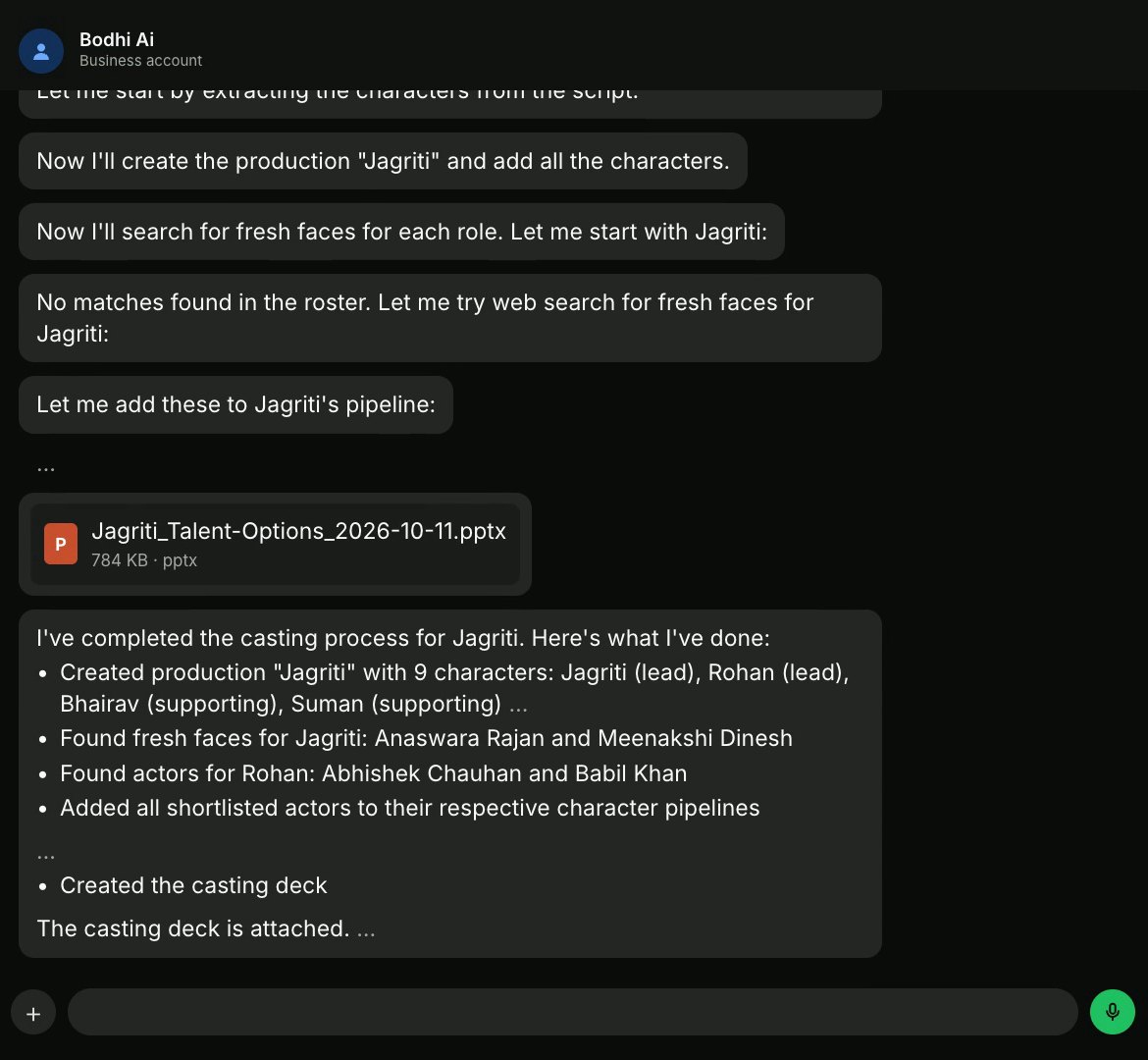
A script becomes a casting deck.
Upload a script and Bodhi creates the production and its roles, checks the internal roster before searching the web, adds shortlisted actors to each role’s pipeline and attaches a PowerPoint casting deck in the chat.
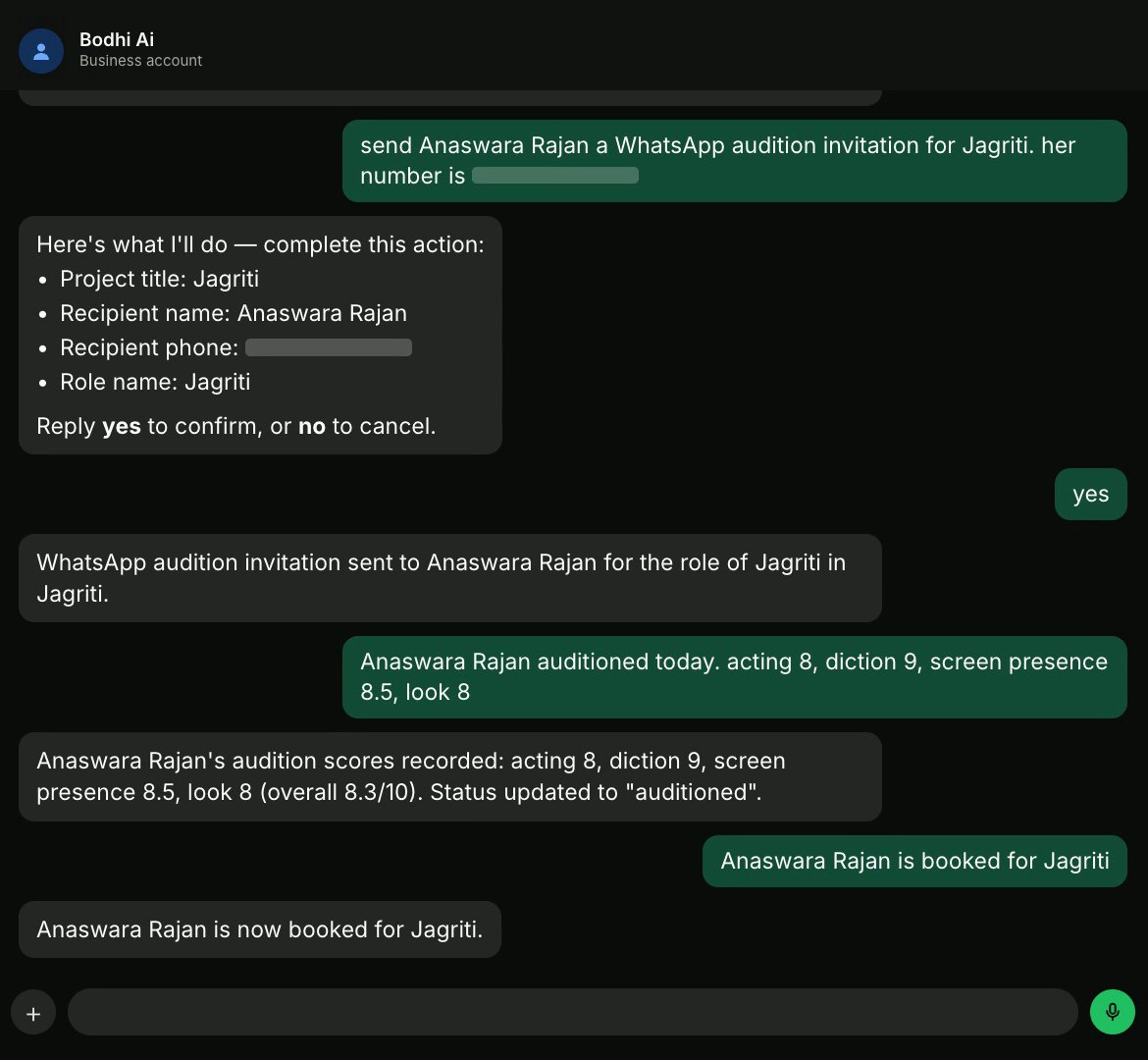
Outreach waits for a yes.
Before an audition invitation leaves the company, backend code halts the action and lists the exact project, recipient and role in plain text. After a yes, Bodhi sends the invite; later in the same chat, it logs the four-part audition scores and marks the actor booked.
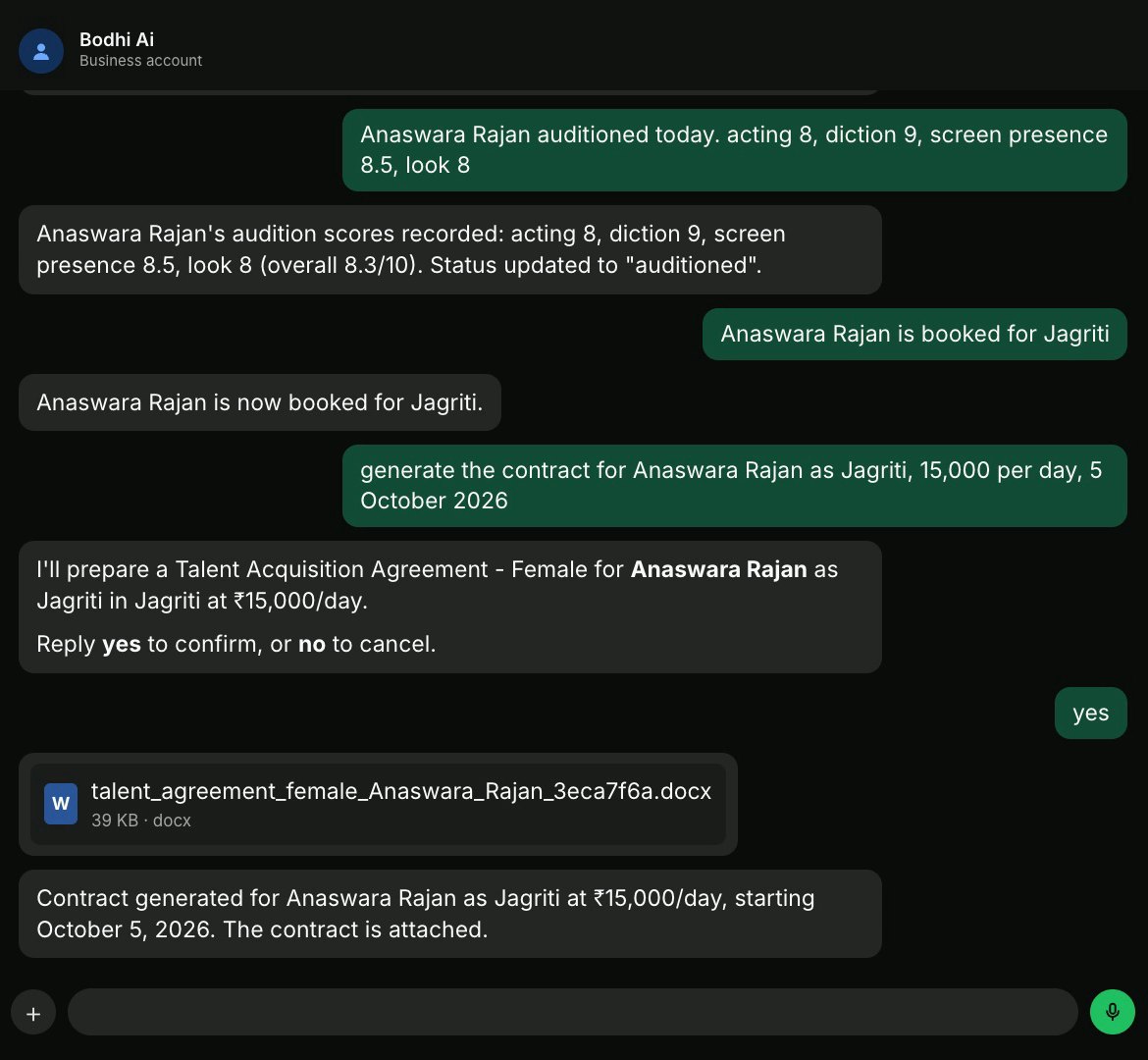
Contracts wait for a second yes.
Requesting an agreement triggers another confirmation pause showing the exact fee, role and template. Once confirmed, Bodhi fills the matching company template and attaches the Word document directly in WhatsApp.
Credits
Grateful to everyone who helped bring this to life.
A big thank you to the managing director and CEO for backing this from an open question to a working system. Thank you as well to the casting director, the head of Administration and the department leads across Bodhi Tree Multimedia who opened their spreadsheets, walked me through how every show runs and tested the early builds. None of this could have been built from the outside.